
Category: Dating Culture

Dating culture as it really is. Explored through questions, opinions, polls, and real conversations. From talking stages to unspoken rules, and hot takes, nothing is off the table here.

  • The Talking Stage: Do You Owe Loyalty In One?

    The Talking Stage: Do You Owe Loyalty In One?

    Photo by Priscilla Du Preez 🇨🇦 on Unsplash

    One of the fastest ways to start an argument in a room full of single people is by asking whether the talking stage should come with an exclusivity clause. Some people think it’s basic decency, and others think the whole idea of exclusivity without a label is a level-5 disaster dressed up as romance. 

    We asked our contributors a simple question: “Do two people in an undefined talking stage owe each other loyalty?” 

    We got enough responses to realize that there isn’t a universal consensus on this. However, we did find out that most answers to this question fit neatly into one of three categories. 

    No Label, No Loyalty

    Mel, 34

    You owe truth. Not loyalty.

    Ibiso, 22

    I honestly think a person in a talking stage can entertain others, because you’re yet to decide if you’re going to end up with that person. So you can definitely entertain others, pick the best among them, and let the rest go.

    Laura, 24

    Until things are defined, I don’t think there should be any loyalty. That’s why I don’t encourage long talking stages. Things should be defined as early as possible.

    Abapres, 22

    The person you’re in a talking stage with can disappoint you, or you might wake up one morning and find out that you’re no longer interested in them. So you don’t owe them that. Loyalty is reserved for people in serious relationships, marriages, and friendships.

    Loyalty Isn’t Optional

    Sharon, 22

    When I start talking to someone, they have my full attention for that period of time. I can’t split myself into different parts just to entertain multiple people. Especially when I know that I already like one person. 

    I know they say we shouldn’t place all our eggs in one basket, but why not?

    Hannah

    At the beginning, I would understand it if a guy says he’s talking to other people. But when things start getting serious between us, I expect loyalty and their undivided attention.

    Angel, 23

    If exclusivity is communicated from the beginning, then yes. The way I see it, it’s all about making sure nobody assumes the other person has to be loyal when that was never discussed.  The important thing here is communication.

    Loyalty on a Sliding Scale

    Doreen, 21

    It really depends on how far you’ve gone in getting to know each other. If you’re communicating and connecting seamlessly, and deep down you both know something real is happening, why would you jeopardize that? 

    But ultimately, it’s still each person’s decision to make, because you could have a strong connection with more than one person during that time. So no, I don’t think they owe any loyalty. At least, not yet.

    Mules, 20

    It depends on how long you’ve been entertaining each other or how intense things have gotten. If you guys have been talking for some time and it’s noticeably heading into relationship territory, then yeah, I feel you should be loyal 

    Tomi, 27

    I assume that in the talking stage, someone is being wooed. There’s no reason for you to be wooing multiple people at once. That’s also why a talking stage shouldn’t last too long; otherwise, you have two people who aren’t exclusive but demand exclusivity.

    Is Full Disclosure a Courtesy, an Obligation, or Nobody’s Business?

    The question on loyalty gave us a bunch of mixed reactions, and also showed that a good number of people were open to entertaining more than one person at a time. So we followed up with a related question: “Is being upfront about talking to someone else a courtesy, an obligation, or none of anyone’s business?”

    Again, we ended up with a mixed bag.

    Angel, 23

    It’s an obligation. You both need to be on the same page from the start. So, if one person is allowed to talk to other people, then the other should be. 

    Layla, 32

    It’s nobody’s business. Unless either party is being physically intimate with the people they are entertaining, I don’t see the point in disclosing that. 

    Hannah

    Yes, please. It’s an obligation. Mostly because I would like to know where I stand. I wouldn’t want to be the only one stuck in La la land.

    Seyi, 26

    I don’t think you’re obligated to disclose that, but I like to subtly remind people that they aren’t the only ones I have my eye on.

    Uzochi, 31

    Honestly, it’s more of a courtesy than an obligation. I think once it’s clear that both people are actually going somewhere and considering moving things forward, then being upfront about talking to other people matters.

    But in the very early, casual stages? I don’t think it’s anyone’s business yet. At that point, nothing has been defined, so you can’t really expect that level of transparency.

    The bottom line

    You don’t owe people exclusivity simply because they’ve shown an interest in you.

    What you might owe them is honesty, and how much of it you owe depends on how well things have developed between you both. 

    While you might not owe anyone a status report on your dating life two weeks into speaking to them. You probably owe some disclosure to someone you’ve been texting every day for three months straight.


  • 7 Green Flags That Matter More Than Grand Gestures

    7 Green Flags That Matter More Than Grand Gestures

    Photo by أخٌ‌في‌الله on Unsplash

    Somewhere along the way, we decided love had to be a grand production to be real. That it needed a hidden camera, a caption-worthy moment, or something good enough to post, otherwise, it didn’t quite count. We built an entire industry around convincing people that if their partner isn’t planning something elaborate, they’re not trying hard enough.

    Nobody necessarily sat you down to teach this. It just showed up everywhere — in movies, the way people talk about their relationships online, the viral proposals, and in the quiet comparisons you make when someone else’s partner does something, and yours doesn’t.

    Somewhere in there, the quieter markers of love that hold up over decades got buried under the ones that make for a better story.

    And don’t get us wrong, a grand gesture now and again is wonderful, but they are smaller, more sustainable, and dare I say, more meaningful ways to express love consistently.

    1. Remembering the small things.

    Not the big, calendar-marked stuff like anniversaries and birthdays. Those get remembered because they have to be. But you can’t deny that it’s a pretty great feeling when your partner remembers a detail you mentioned weeks ago in passing. The coffee order you got only because you wanted to try something new but now absolutely love; the coworker you complained about. The coworker you complained about one time, and now every time their name comes up, your partner’s face does that little scrunch that says “oh, we don’t like this one,” without you having to remind them why.

    2. Staying Consistent

    Three months in, they were opening doors, planning the dates, replying within the hour. A year in, half of that might be gone, and while it’s easy to write some of it off as “getting comfortable,”  it’s not okay when comfortable becomes a synonym for careless. 

    Consistency is the ultimate green flag because it proves their care isn’t just a temporary show to win you over.

    3. Doing Things Without Being Asked

    Noticing what someone needs before they’ve said it requires you to pay attention to the smaller details. 

    That kind of attentiveness is one of the clearest expressions of love there is. It doesn’t ask for credit or expect applause; it simply shows you that you are cared for.

    A partner who anticipates your needs quietly provides a sense of security that a grand gesture simply cannot replicate.

    4. Handling Disagreements Without Disappearing

    It’s easy to be a good partner when nothing’s wrong, but it’s a different thing entirely to stay present when things get tough.

    Choosing to stay when things get heavy means resisting the modern, easy impulse to ghost, stonewall, or ice people out the moment discomfort arises. It is the conscious, active decision to sit in quiet discomfort with a partner rather than vanishing behind a screen or seeking the nearest exit.

    5. Speaking about you the same way in every room.

    There is a subtle loyalty in a partner who protects your name/reputation in your absence. This means your quirks, vulnerabilities, and feelings are completely safe in their hands, whether they are talking to their family, coworkers, or friends,  and they don’t diminish how much they value you just to score brownie points.

    6. Leaving Room for the Rest of Your Life

    A healthy relationship does not isolate you, and a secure partner understands that your relationship does not need to consume your entire life to be real. 

    They don’t view your friends, family, or coworkers as competition for your affection or attention. Instead, they appreciate the fact that you have a full, meaningful life outside of them.

    7. Knowing How to Apologise 

    Apologizing means admitting you were wrong, and for a lot of people, that feels like losing, so they deflect, over-explain, or turn the conflict into a debate about who is more at fault instead of simply apologising. 

    The focus should be entirely on repairing the connection rather than winning an argument, and having the strength to own and apologize for a mistake without attaching a disclaimer to it.

    Conclusion

    We need to stop measuring the depth of someone’s love by the scale of their theatrics. Grand gestures are a fun bonus, but they don’t make for a great foundation.

    The next time you find yourself comparing your relationship to a curated highlight reel online, remind yourself of this: True love doesn’t need a camera crew or a clever caption to count. It just needs two people who show up for each other, day after ordinary day.

  • Common Dating Phrases Decoded

    Common Dating Phrases Decoded

    Image Credit: Towfiqu barbhuiya on Unsplash

    If you ever find yourself having to  decode what someone is saying to you or their intentions toward you, chances are it probably wasn’t good to begin with, and that’s the real premise of this list. 

    Dating in 2026 comes with its own language, and a lot of these phrases are intentionally set up to be chaotically neutral. In theory, they sound like honest expressions of where a person is at, but in reality, there’s usually a gap between what they’re saying, what you’re hearing, and what you should be hearing.

    To be fair, not every phrase below deserves a side-eye solely based on what’s being said. It’s also important to take into account the person saying them  to see if their actions back up or contradict the point you think they’re trying to convey.

    Ambiguous Phrases Commonly Used in Modern Dating

    None of these phrases are particularly new. They’re all seasoned veterans of the dating world, and repeat offenders who somehow keep showing up at the scene of almost every crime. And because they keep showing up, it’s time we unraveled them and showed them for what they are so people stop getting confused by these somewhat ambiguous statements.

    So here’s our list of eight commonly used phrases in the dating world, and what they really mean once you decide to take the rose-coloured glasses off.

    1. “I’m not ready for a relationship right now”

    Oftentimes when you hear this, you don’t think it’s personal. You convince yourself that it just isn’t the right moment, which makes it easy to want to wait it out and stay hopeful that timing will eventually align.

    What you should probably be hearing is “I don’t want to be in a relationship with you.” because, as is often the case, the “with you” is usually silent.

    While timing does play a part when it comes to matters of the heart, timing is rarely ever the real issue. If someone were genuinely interested in you, “not ready” tends to take the form of a slower pace, not avoidance. 

    This phrase is usually less about avoiding relationships entirely and more about the maker searching for an exit plan that doesn’t involve explaining their lack of interest in you.

    2. “Let’s go with the flow”

    “Going with the flow” sounds great — no pressure, no immediate expectations, just two people seeing if what they have could blossom into something more.

    The statement itself isn’t inherently bad. What everyone needs to watch out for are the actions that accompany it, because that’s what your understanding of the statement should be based on. 

    On one hand, it could be the low-stakes dynamic where you both get to figure things out gradually, and on the other, it could be the situation everyone dreads: having the statement made by someone who is actively running away from commitment but still wants the comfort of having you around.

    It’s important to figure out which one you’re dealing with, so you don’t find yourself five or six months down the line realizing that you’ve somehow wound up in a situationship.

    3. “I don’t want to rush into anything”

    This might seem similar to “let’s just go with the flow,” but the two show up in very different stages of dating. “Let’s just go with the flow” typically shows up in the very early stages, while this often shows up after weeks or months of consistent communication, right around the point where things would naturally need to progress into something more. 

    More specifically, it usually shows up in response to the “where is this going” question.

    On the surface, it’s unreasonable. Nobody wants to be pressured into something before they’re ready. But when it’s used as a response to a direct ask, it’s more often than not, a way of avoiding giving an actual answer to the question asked.

    4. “I’m not a fan of labels”

    Some might consider it too harsh to classify this as an immediate red flag (even though we absolutely think it is), but it should, at the very least, be classified as an amber flag because it’s the kind of statement that should make you pause and ask questions.

    Labels exist for a reason. They’re how people agree on what they are to each other and to everyone else. Even more, it’s the foundation on which certain boundaries are built on or can be implied from. 

    People who avoid labels but want all of the benefits that come with it — the exclusivity, the attention, the access to a person — are doing one thing and one thing only: avoiding accountability.

    And honestly, it’s a little silly when you think about it because if you’re already living the reality the label represents, why is the label itself so scary to you?

    5. “I’m such a bad texter”

    This one comes with built-in plausible deniability because everyone knows someone who genuinely struggles with texting back, so it sounds believable, and that believability is exactly why it works so well as an excuse.

    It plays into the way people already tend to treat texting like it’s some flimsy, unimportant thing, which it isn’t, because at the end of the day, it all balls down to communication, and communication is one of the ways you show someone that you prioritize them.

    The key difference between someone who cares about you and someone who doesn’t is quite easy to spot. The question here is: is an alternative being offered? 

    For example, a person who says “I’m bad at texting, but I love calls and I love FaceTime, can we do that instead?” is a person still trying to find a way to show up for you, even though they are genuinely bad at texting. 

    “I’m just bad at texting.” with no alternative or compromise offered, is a convenient excuse from someone who doesn’t have much interest in you or in getting to know you, and it should be treated as such.

    6. “I’ve been so busy”

    This is probably the most universally used excuse in modern dating, probably because of how convenient it is. Because while you want the person you’re interested in to have time for you, you also don’t want them to seem jobless. Not literally jobless, but the kind of “always available” that makes you start questioning whether they actually have a 9-to-5 or anything else going on in their life.

    The point is, no one is busy twenty-four seven. Everyone has stretches where they’re occupied with something else, but that has never once stopped anyone from responding to people they actually care about or are genuinely excited to talk to.

    The tell here is whether some communication happens beforehand. Someone who says “heads up, today is going to be a lot, so my responses might be slow” doesn’t raise any red flags when their responses eventually slow, because you’re not left sitting there wondering. 

    On the other hand, if someone is known to disappear for days on end and pop up with “I’ve been so busy the last couple of days” as an excuse, that is a problem.

    7. “It’s not you, it’s me”

    The funny thing about this is, they’re right. It’s not you, it’s them. But it isn’t the humbling admission you think it is.

    For years, people have said “it’s not you, it’s me” while secretly believing the opposite. In truth, they don’t think the problem is them at all. The real problem is that they don’t want you, and they’ve decided to tell you that in a very roundabout way.

    “It’s not you, it’s me” is the dating world’s version of the sandwich method — compliment, criticism, compliment. That’s why the rejection gets dressed up to look like a compliment when it really isn’t.

    If you find yourself constantly reaching for this line, this is your sign to act like a grown-up and be straightforward when trying to let someone down. 

    You don’t have to be mean about it, but you can let someone know that something isn’t working or isn’t going in the direction you thought it would, without digging up this tired, overused line.

    8. “I feel like we just get each other”

    This is the worst possible response you can get when you’re asking about your future with someone.

    More often than not, it comes from someone whose inconsistent actions have already made you question whether you have a future with them in the first place.

    So you ask, hoping for clarity, and instead of an answer, you get “I feel like we just get each other. We know what we’re doing, and we know where this is going.” When in truth, neither of you knows where this is going. 

    The person saying it is stalling, for whatever reason. And you, the one who asked, still don’t have your answer — an answer you wouldn’t have needed to go fishing for in the first place if you really knew where things were going.

    The tragic thing about this is that it can show up at any stage of dating. It can show up really early on, before you’ve made things official, or after you’ve made things official, and are at a point where you believe things should have progressed to the next level. This could be meeting their family, moving in together, or getting engaged. 

    Either way, this reply doesn’t answer your question, so be sure not to settle for this as an answer. Ask again. Ask in a different way if you have to. Just ask until you get a response that lets you know where you stand.

    Conclusion

    Our list isn’t exhaustive. There are plenty of other phrases floating around the modern dating scene that deserve the same level, or even more, of a side-eye than these. And while we can’t catch every single one of them, it’s helpful to be armed with the basics. 

    However, the bigger takeaway is knowing that there are some things to take at face value and some things you absolutely should not.

    Finally, this is not a public service announcement to jump to conclusions every time someone says something, but it does help to read between the lines every now and again, because sometimes it just might tell you more than you need to know.

  • What a Situationship Actually Means and How to Tell If You Are in One

    What a Situationship Actually Means and How to Tell If You Are in One

    Image Credit: Markus Winkler on Unsplash

    Ah! The situationship. The soul-sucking grey area of modern dating that a good number of us have come to know and hate. While widely known as the place where all hope of romance comes to die, and arguably an unending source of trauma for all its unwilling victims, there still seems to be some confusion as to what a situationship is.

    Luckily, we’re more than happy to clear that up.

    What is a Situationship?

    A situationship is a relationship in everything but name. It’s basically two people cosplaying a relationship while refusing to define it as one. It has all the intimacy, routines, and closeness reserved for people who are actually together, but it’s constantly shadowed by the question: “What are we?”

    Situationship vs. Talking Stage: What’s the Difference?

    This is where things tend to get a bit confusing, so let’s clear it up. A talking stage has direction. A situationship does not.

    In the talking stage, both people are aware that they are, for lack of a better word, being auditioned for something. There’s an unspoken (sometimes spoken) understanding that you’re figuring out if you’re compatible enough for a relationship. It’s tentative, but it’s moving somewhere.

    A situationship, on the other hand, has already had all the time in the world to figure out if it can become something or not. But oftentimes, you’d find that one half of this pairing is content to make a home in this grey area of uncertainty. 

    Situationship vs. FWB: What’s the Difference?

    The difference here is honesty and clarity. A Friend With Benefits dynamic is a situationship’s more self-aware cousin, in the sense that everyone involved makes their intentions extremely clear. Both people know exactly what they are getting into: casual, physical, no-strings-attached, and free to see other people. Nobody is confused, and nobody is under the misconception that it will turn into anything more.

    A situationship never gives you the dignity of having that conversation. 

    Telltale Signs That You Are in a Situationship 

    While every situationship has its own flavor of chaos, there are a few foundational signs that cut across them all.

    1. It’s a relationship in all but name

    It looks like a relationship, talks like a relationship, and walks like a relationship, but isn’t a relationship. 

    You’re both “going with the flow.” Which, in theory, sounds harmless. Going with the flow is fine as long as “the flow” is actually going somewhere. And in this case, it isn’t.

    Basically, you exist in one of Schrödinger’s experiments if he were a love doctor and not a physicist. Simultaneously together and not together, with no one willing to open the box and check.

    2. It feels like there’s an invisible leash

    You’re not exclusive, but the thought of entertaining anyone else feels like cheating. 

    Sometimes it’s because of the flicker of jealousy, manufactured to keep you in check the moment someone else shows interest in you, or the moment you seem remotely interested in someone else. 

    Other times, you’re kept on a leash by something that sounds like the promise of a future but somehow falls short of one.

    The popular culprits are usually something along the lines of, “I’m not ready for a relationship right now,” or “I’m still figuring a couple of things out,” said with neither the intention nor the enthusiasm of someone who’s being honest, but with just enough conviction to make it sound like there’s one small, temporary obstacle standing between you and something real.

    Either way, you end up giving relationship-level loyalty to someone who offers seasonal breadcrumbs to keep you right where they want you.

    3. There is no future in sight

    Apart from the somewhat constant communication, random 2 a.m. “you up?” texts, and a movie date now and again, there’s really nothing more to this “relationship.” 

    No conversations that hint at any form of progression, no mention of meeting their family, and although you probably know all their friends by name, you’ve never met a single one. If you have, you’ve never been introduced as anything more than a friend.

    The relationship exists solely in the moment, contained entirely between the two of you, with nothing that suggests it extends any further than that.

    Am I In a Situationship or Just Moving Slow?

    Before you diagnose yourself, it’s important to know that not every undefined thing is a situationship. Some people are simply slow burners, and there’s absolutely nothing wrong with that.

    The major difference here is that there’s a clear progression in your relationship, and there are a few simple ways to tell. 

    • There’s been an actual conversation acknowledging what you both are or could be, even loosely.
    • The amount of effort being dedicated to what you have keeps escalating over time. You spend more time together, get increasingly vulnerable with one another, and develop a sense of trust
    • You’ve met at least some people who matter to them.
    • They don’t flinch or deflect when you talk about wanting more.

    Conclusion

    At the end of the day, a situationship is more than an inconvenience because when left unresolved, it may start to chip away at your self-esteem and, in more toxic cases, your mental well-being. 

    So if you’ve read this far and recognized a little too much of yourself in it: it might be time to ask the question you’ve been avoiding. Not because clarity is a nice-to-have, but because you deserve to know if you’re building toward an actual relationship, casually dating someone, or simply getting your time wasted.

  • First Date Questions That Will Save You A Lot Of Time And Heartache

    First Date Questions That Will Save You A Lot Of Time And Heartache

    Image Credit: René Ranisch – Unsplash

    First dates have a way of following the same script. Everyone shows up wanting the same thing: to figure out if this person is actually worth their time, but nobody wants to be the one who makes it feel like a job interview. So instead, people stick to the safe, standard first-date questions: their job, their last holiday, whether they prefer cats or dogs (a question that has never told anyone anything useful, ever). As long as the vibe is good and the conversation flows, everything is peachy. 

    And then three months later, you’re fully invested in someone, completely convinced that they’re your person, only to find out something so fundamental about them that breaks the whole thing apart. Not necessarily because of betrayal or because the feelings between you and the love of your life aren’t real, but because somewhere earlier, there was a conversation that could have changed the whole trajectory of the relationship, but no one thought to have it. 

    That’s the thing about the early stages of dating. The questions that actually matter rarely come up because they feel like too much, too soon. And fair enough, not everyone is built for directness. Some people will ask anything, straight up, without flinching, while others would genuinely rather chew glass than say something that might come across as too heavy.

    So we put together a list of first date questions we think will save you a lot of time — almost as much time as Tova’s preference settings already saved you. And because we’re nothing if not thorough, we also took the liberty of adding softer alternatives for those who would rather not ask some of these directly. 

    1. What are you looking for right now?

    This is the one question everyone knows they should ask, but almost nobody does. Instead, people spend weeks, sometimes months, in situationships, talking stages, and almost-relationships, carefully avoiding the one question that would tell them everything they need to know. 

    Contrary to popular opinion, asking this question this early isn’t desperate or intense; it’s simply a really efficient way to avoid getting your time wasted. It’s also the most important question on this list because the answer determines whether you’re going to spend the rest of the date asking the questions below, or just running out the clock until you can politely leave.

    For those who’d love to ask this question, but are afraid of coming on too strong, try asking if they find dating fun or if it feels like more effort than it’s worth these days.  It’s disarming enough that people actually answer honestly, and you can pick out the serial “daters” from the people looking for real connections.

    2. Do you want kids?

    With declining birth rates and the number of people actively choosing to remain child-free, making the linear “find a partner, get married, have kids” assumption might do you a lot more harm than good. Which is why this is a very important question because it’s one of those questions that, if left unasked, can do a lot of damage in the long run. At the same time, it’s a heavy enough question that leading with it on a first date might have your date mentally calculating how fast they can get to the exit, so we totally understand why a person might choose not to ask it outright, which is why we are sharing our little roundabout method. 

    First off, we advise that you weave it naturally into small talk and put that “cat or dog person” question to good use. Start there and then follow it up by asking whether they grew up with pets. And whatever their answer is, ask if they’d want their kids to grow up with pets. Most people will answer without realising what happened. 

    3. Where do you see yourself living long term?

    Some might wonder why this made it to the list, and if you are, I’m genuinely happy for you because that means you haven’t had to delude yourself into thinking a long-distance relationship could work after waking up to the news that the person you’ve spent the last seven months falling in love with is moving from Austin, Texas to Alaska. So let’s keep it that way, shall we?

    This question is an extremely important one when it comes to diaspora dating, because “home” is rarely a straightforward answer. Some people are here temporarily, some moved with no intention of going back, while for some, their current location is a stopover while they figure things out. All three of these are valid, but only one of them is compatible with your plans, so you should probably find out which it is before you start catching feelings.

    For those who’d rather ease into it, put your small talk to good use. Ask questions like “If you could pick any city in the world to call home, which one would it be?”   Let them dream a little. Then follow it with “more realistically, where do you see yourself putting down permanent roots?” 

    4. What role do your family and friends play in your life?

    This question is less about how close they are to the people in their lives and more about how much those people influence the decisions they make. There is a meaningful difference between someone who values the counsel of the people they love and someone who cannot make a move without a group vote. While one suggests that a person is emotionally grounded, the other means you are signing up to date not just them but their mother, their three best friends, and whoever was able to get into their head first.

    A good way to figure out where they fall is by asking something like “Are you someone who makes decisions pretty independently, or do you like to talk things through with the people close to you first?” It’s a simple and effective way to find out exactly how much outside noise you’re signing up for.

    5. Relationship Patterns 

    This is a three-fold question, and the goal is to determine whether your soon-to-be beau is cut out for a serious relationship. The best way to do this is by figuring out what their track record looks like. i.e., have they ever been in a serious relationship, how long did it last, and how did their previous relationships end.

    These three questions are best asked in sequence because each one builds on the last, and together, they tell you more about a person than almost anything else on this list. These questions give you insight into their ability to show up for someone long-term, how long they are capable of sustaining something real, and, perhaps most importantly, how much self-awareness they have about the role they played and how it resulted in the end of their previous relationships.

    That answer to the last question is worth paying close attention to because someone who can reflect honestly on why a relationship ended without rewriting history or casting themselves as the victim in every story is a person who knows how to hold themself accountable.  

    To get your answers without making it feel like a sit-down interview, start with a simple “have you ever been in a serious relationship?”, let them talk, then follow up with “what’s the longest one you’ve been in?” By the time you get to the “why did it end?” question, the conversation has already done enough of the work that it feels like genuine curiosity — which it is.

    6. Are you friends with your exes?

    There isn’t a universally acceptable answer to this question. It all depends on what you’re comfortable with. Some people maintain cordial relationships/genuine friendships with exes, and there is nothing necessarily alarming about that. What you need to know is the reason that relationship still exists, whether decent boundaries are in place, and whether anyone is quietly holding out hope for a reunion.

    To start things off, you can simply ask what their perspective on being friends with exes is. And then follow up by asking if they are friends with any of their exes. 

    7. What does your ideal relationship look like?

    This question surfaces a lot at once — expectations, gender roles, how they think about partnership, whether they believe in 50/50 or have a more traditional idea of how things should be divided. People will tell you exactly who they are when you ask them to describe what they want, because a person’s wants in a relationship is almost always a reflection of how they see themselves in one.

    Asking questions like “What’s something you feel really strongly about when it comes to how a relationship should work?” is a great start to understanding what a relationship with a person is going to look like.

    8. Is faith something that plays a big role in your life? 

    This is an important question to ask because assuming you already know the answer based off a person’s perceived background is never a good idea. 

    In some cases, it isn’t particularly alien to find out that faith is less of an active personal choice and more of something that was culturally inherited, and this affects the way/the extent to which a person’s faith is expressed, practiced, or how much of it informs the decisions they make. This means the question that should be asked isn’t merely what religion they identify with but how that belief shapes them. 

    There isn’t really a roundabout way to ask this. It needs to come up directly. The easiest way to get there is by sharing where you stand first, and giving the other room to express themself. That way, you take the pressure off and it flows like a conversation rather than an interrogation.

    First dates are a lot of things — nerve-wracking, exciting, and occasionally, a great story you’ll be telling for years. But more than anything, they are an opportunity to find out whether the person sitting across from you is worth pouring more of your time into.

    So ask the questions. All of them, if you can. And if you can’t bring yourself to ask them directly, you now have the softer routes in. Either way, your future self will thank you. 

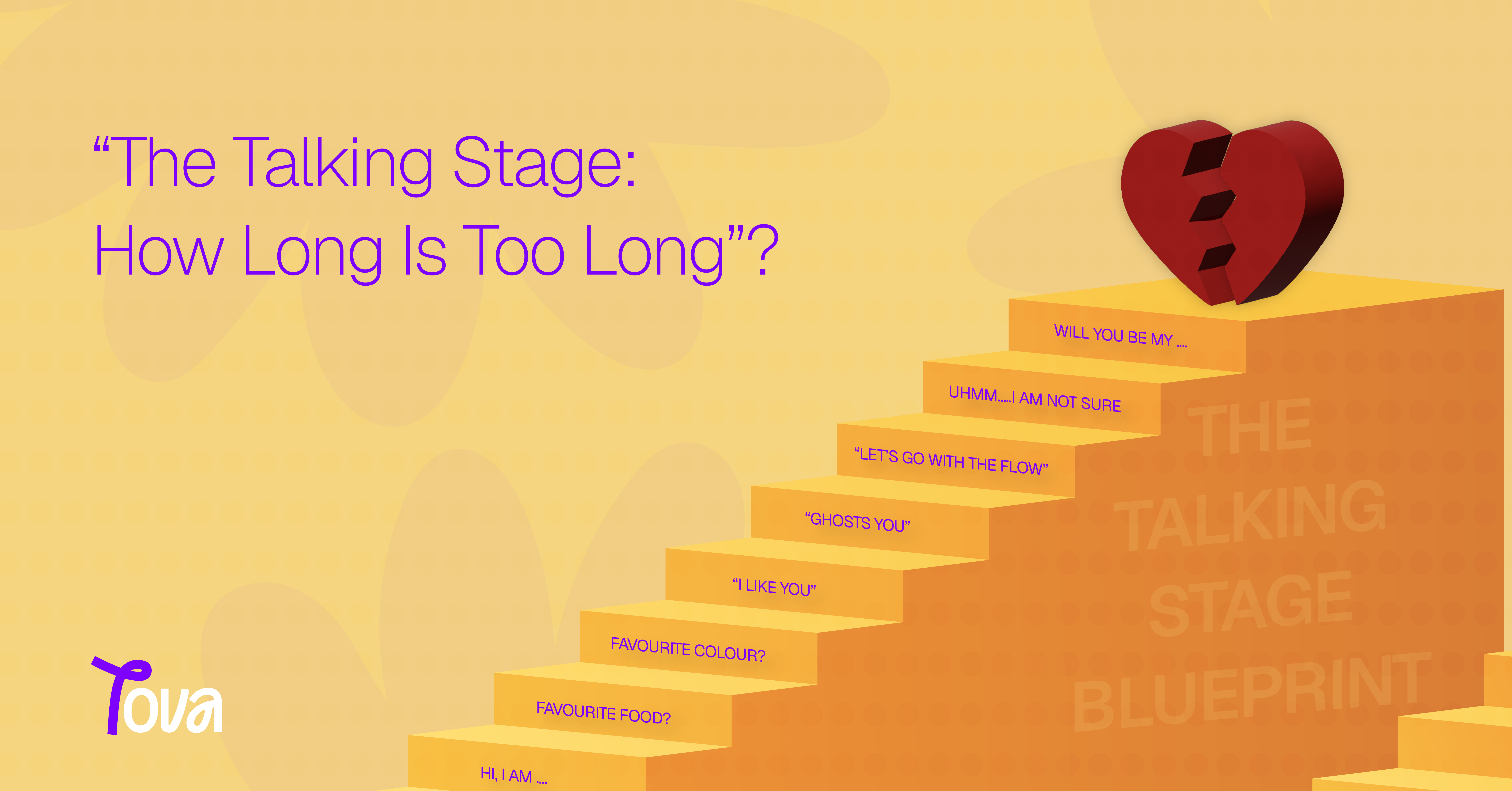
  • The Talking Stage: How Long Is Too Long?

    The Talking Stage: How Long Is Too Long?

    There are very few things in modern dating that people have stronger opinions about than the talking stage. Ask ten people how long it should last, and you will get ten different answers, a few situationship stories, and at least one person who refuses to acknowledge the talking stage as something that’s remotely necessary. We know this because we asked, and that is more or less exactly what happened.

    Our responses came from men and women between their twenties and forties, across different relationship situations, and with varying levels of patience for romantic ambiguity. What they shared was refreshingly honest, some a little chaotic, but definitely not boring.

    Everyone has a number

    The “average” consensus, if you can even call it that, leans firmly toward three months or less. But the reasoning behind the numbers is where things get interesting.

    Uzochi, 31

    Keeps it at two to four weeks:

    “I get that you can’t fully know someone in that short period, but you should at least have a sense of whether you want to move things forward or not. At some point, it’s either progressing, or it’s just dragging on.”

    She is also candid about what happens when you ignore that instinct. Her most recent talking stage stretched into two years, and she traces it back to one early warning she did not act on. She does not recommend it.

    Eli, 23

    Personally, I think it depends on how the relationship starts. Some people start off as friends and then grow into something more, which could take anywhere from a couple of months to years. But if from the beginning the intention is to be in a relationship, then I would say three months.

    NosNos, 26

    Lands in a similar window, but for her, it is less about impatience and more about having a clear purpose.

    “I understand that, given the times we live in, many people end up with partners who are not who they initially presented themselves to be, which can be a major challenge.. However, in a talking stage, the primary goal is to evaluate whether the person you are engaging with is someone you truly want to build a life with. 

    During this time, you ask meaningful questions that reveal patterns about their relationship dynamics, level of financial literacy, character traits and flaws, values, and religious alignment. If physical appearance is high on your priority list, that is also a great time to reflect on whether you are willing to compromise in that area if other important qualities are in place. 

    This stage is not a relationship; it’s an evaluation of the potential to become one. Most of us know what we want, and if you are still unsure, it’s better to figure that out before making yourself available.” 

    Seyi, 26

    The talking stage is the period before the first date, and that should not last longer than two weeks. We can keep talking while we go on dates. Ideally, we should be in a defined relationship after three months. 

    Also, don’t shy away from asking questions for clarity. I say this because my longest talking stage went on for four months. We were going on dates and everything, but I noticed he wasn’t talking about the next step, so I initiated the conversation, and as soon as he said he wasn’t ready for a relationship, I was out. Nine months later, he was engaged to someone else. Men know what they are doing. Don’t allow anyone waste your time.

    Egooyibo, 22

    A talking stage should typically last around three to four months. That’s enough time to decide if you want to be with someone exclusively/spot any red or green flags without rushing. 

    If it stretches past 4 months without clarity, that’s just a lack of intention. At that point, define things or put an end to the situationship, because you shouldn’t invest too much time in someone/something that’s uncertain.

    Akin, 24

    Caps it firmly at two months, and his reasoning is less about romance and more about accountability.

    “A talking stage shouldn’t be longer than 2 months. Once it exceeds this time frame, I personally believe that both parties are not ready to commit to one another. Two months is enough for people to get to know one another. We’re adults for crying out loud. We must be accountable.”

    Layla, 32 

    A talking stage shouldn’t last long. Have I kept up with that principle? No, but I digress. 

    The talking stage is merely a vetting process. It’s either you know what you want or you don’t. Ideally, 2 weeks or less should be enough time to make a decision.

    Oluebube, 22

    6 months. Honestly, I see no reason why someone would be in a talking stage for a year. I find it ridiculous. If your excuse is “ I’m trying to know him/her better,” you’re in for a long ride because people change, and you can never truly know someone’s true character.

    And when asked what they’d say to someone who’s been in a talking stage for four months or more… 

    NosNos, 26

    My dear, four months?  Honestly, four months is a lot of time.  I won’t say it’s automatically wrong, but I think it’s too prolonged and is indicative of a lack of direction or clarity.  Personally, I would never speak to someone for more than a month.

    Ace, 29

    I’d be interested in what they’ve been talking about.

    Zara, 22

    I wouldn’t judge. I would believe he or she knows what they’re doing by taking their time to get to know someone. Because society might see it as weird does not mean it is, realistically. You can’t put a timeline on how long someone is supposed to get to know another person. That’s a whole stranger they’ve never met before, at least in some cases.

    Oluebube, 22

    If you have been talking to someone for four-plus months, maybe it’s time to do some deep reflection. Ask yourself why you’re hesitating, and if you both share the same values. Asking these questions might not give you the answer as to whether or not to make the relationship official, but it will bring you closer to an answer.

    D, 29, 

    had a simpler reaction.

    “Omo what are you talking about?”

    Eli, 23

    Most times, there’s always that one person in the talking stage who already knows that they are not interested in moving forward. So, save yourself time and move on or confront the talking stage.

    So how long is too long

    Most people who have been in insanely lengthy talking stages say that they were still getting to know the person. And sure, you never fully know anyone, which is why you continue to learn more about them even years into a relationship. 

    When it comes to a talking stage, however, you have one job, and that’s deciding if you want to pursue a relationship with that person. That is it. A talking stage is not a relationship, and should not be mistaken for one. 

    Quite frankly, unless we are trying to solve world hunger, what are we talking about for months on end? If a good amount of time has gone by and you still do not have an answer as to whether or not you want to pursue a relationship with someone, then it’s probably best to let that person go. And if you have decided that you want something more with someone, but they keep telling you they are not ready for a relationship, know that the “with you” is silent.

  • Why Are We Still Embarrassed to Say We Met on an App?

    Why Are We Still Embarrassed to Say We Met on an App?

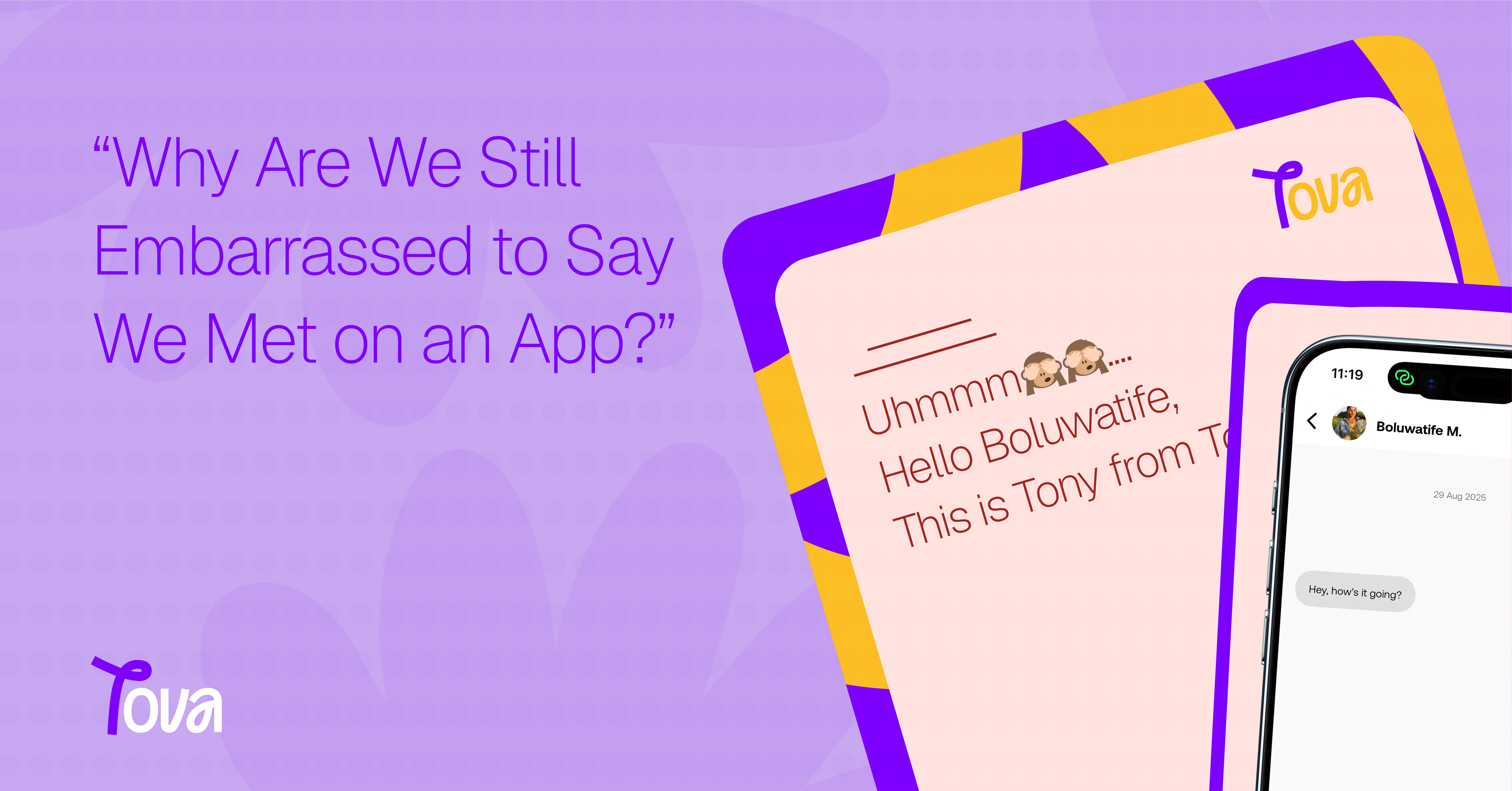
    Dating app stigma — Tova blog post "Why Are We Still Embarrassed to Say We Met on an App?" illustrated with a first message exchange between two users

    Romcoms lied to us. We all know it, and we’re still living by it anyway.

    Somewhere in the 90s, Hollywood made a decision that has caused immeasurable damage to how human beings think about love. The widely accepted trope is: the best love stories are the ones where nobody is trying.

    Think about every romantic comedy you have ever watched. The meet-cute is never intentional. She wasn’t looking, he wasn’t looking, they just happened to crash into each other — sometimes literally, because apparently physical injury is romantic when the lighting is right. After this “crash,” Cupid does his thing, and suddenly, they’re in love. 

    The whole architecture of the romcom fantasy is built on the foundational idea that real love is something that happens to you. Not something you go looking for, not something you plan, and definitely not something you download an app and create a profile for on a Thursday night when you’re tired, a little lonely, and you’ve eaten dinner alone four times this week.

    The problem now is, we have absorbed this so deeply that it has affected our perception of what finding our person should look like to the point where we’ve made intentionality something to be ashamed of. 

    This is where the embarrassment comes from. From the mere admission that you wanted something and you went out to get it like a normal adult human being, instead of waiting for the universe to arrange a convenient collision. The app has nothing to do with it.

    But while the romcom has a lot to answer for, we made things worse.

    The movies were always fiction and we knew that, but that didn’t stop us from collectively spinning that expectation into some form of social hierarchy that places chance encounters on a pedestal and intentional search at the bottom. 

    “We met on an app” has become something people say quietly, with a slight wince, waiting to see if the other person is going to make it weird. And more often than not, the other person makes it weird. There’s usually a slight pause, a small recalibration, and sometimes, some variation of “oh that’s so normal now!” delivered with the enthusiasm of someone trying very hard to mean it.

    Most of us have participated in this. We’ve either said it with the wince, received it with the pause, or even both. We are all, on some level, complicit in maintaining a stigma that, when you actually examine, makes absolutely no sense.

    So Let’s Examine It

    Dating apps have been faulted for their unromantic transactional nature and for reducing human connection to a photograph and a bio that says “I love to laugh.”

    While we can agree that some dating app interfaces have problems, and the “I love to laugh” bio is a crime against self-expression, we’d also like you to consider the alternative.

    What does the organic, accidental, universe-approved method of finding love look like? You go to places, stand there, and hope?  Or wait to get set up by someone’s auntie who describes the person as “very nice and quite tall.” 

    Is the alternative of moving through life permanently hoping for a happy accident really a better option because it creates the illusion that you weren’t looking?

    But being on an app, deciding you want a relationship, saying so explicitly, filtering for people who share that intention, and finding someone who also knows what they want, is the embarrassing option. This is the one we hide at family gatherings.

    The logic is quite flawed. It has always been, and yet, here we are.

    Every Love Story Deserves to Be Told

    The couple who met at a house party and the couple who matched on Tova on a random Tuesday are, at their core, doing the same thing. They are two people, finding each other, and trying to build something beautiful. That is all that really matters.

    The way people meet doesn’t determine the legitimacy of what they’ve built. So, relationships that start on dating apps are not required to prove themselves in ways that chance-encounter relationships wouldn’t be required to. 

    So tell the story — all of it, and without the wince, because the best love stories hardly ever start with meet-cutes that sound like they came straight out of a box-office-smashing romcom.